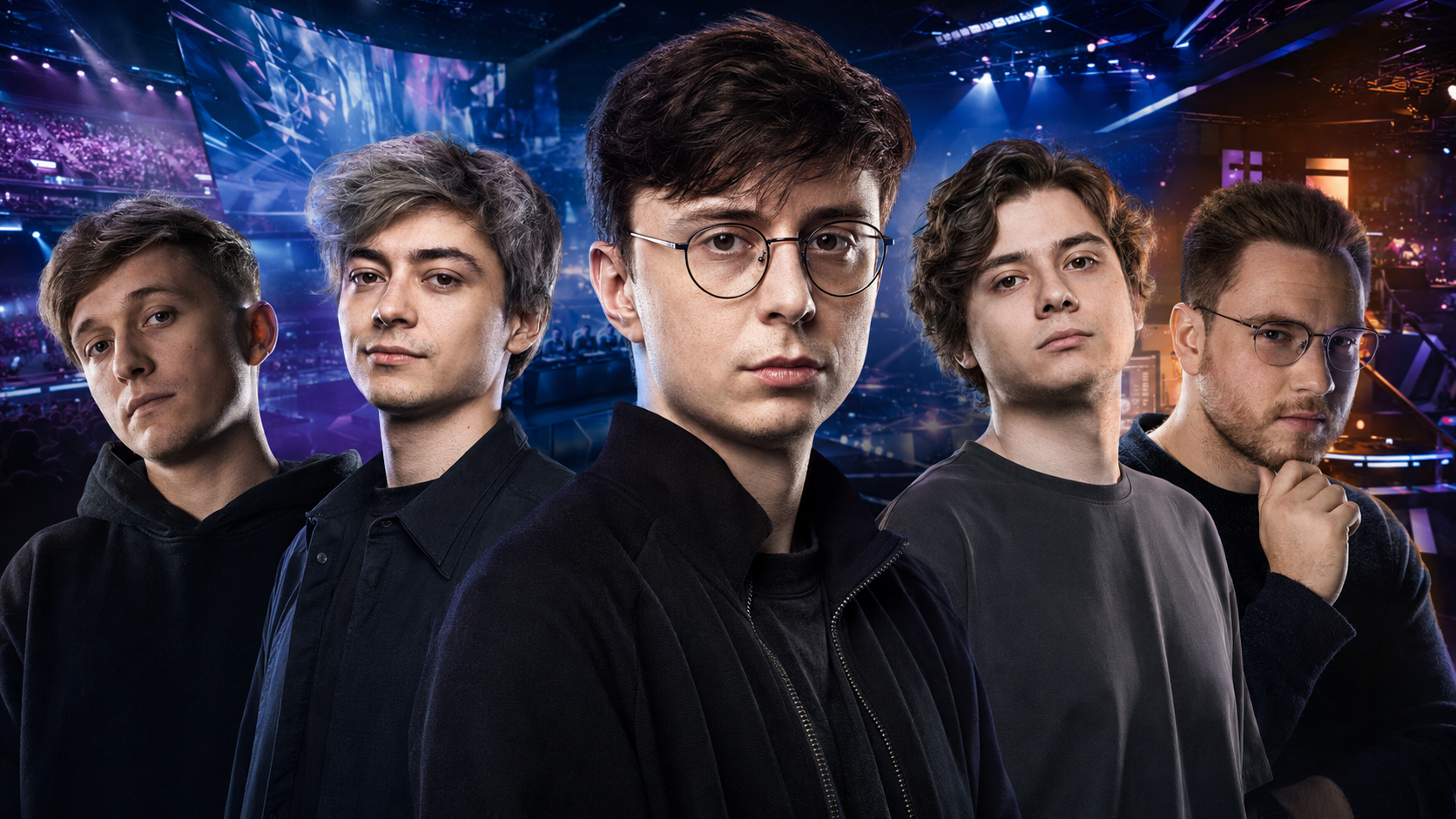
Marc “Caedrel” Lamont was the most-watched esports co-streamer in the first half of 2026. His tournament broadcasts generated 40.5 million Hours Watched, giving him a commanding lead over every other creator in the ranking.
Ivan “StRoGo” Shurpatov finished second with 28.2 million Hours Watched. RAMZES, bySL4M, set1awanade, phonics1, ohnePixel, Wolf, and BaianoTV were among the other creators who attracted millions of hours of esports viewership.
The top 15 co-streaming channels generated more than 216 million Hours Watched during H1 2026. This represented 27.9% of all community-broadcast watch time across the competitive games included in the ranking.
The results demonstrate how important individual creators have become to esports distribution. A growing number of viewers no longer watch tournaments through official broadcasts. Instead, they follow familiar streamers who combine match coverage with analysis, reactions, humor, community discussion, and regional context.
Most-Watched Esports Co-Streamers of H1 2026
The ranking measures Hours Watched generated specifically during esports co-casting broadcasts. It does not include every gaming stream produced by these channels.
| Rank | Streamer | Main game | Language | Hours Watched |
|---|---|---|---|---|
| 1 | Caedrel | League of Legends | English | 40.5M |
| 2 | StRoGo | Counter-Strike | Russian | 28.2M |
| 3 | RAMZES | Dota 2 | Russian | 14.9M |
| 4 | bySL4M | Counter-Strike | Russian | 13.8M |
| 5 | set1awanade | Mobile Legends | Indonesian | 13.6M |
| 6 | phonics1 | League of Legends | Korean | 13M |
| 7 | ohnePixel | Counter-Strike | English | 12.2M |
| 8 | Wolf | League of Legends | Korean | 11.2M |
| 9 | BaianoTV | League of Legends | Portuguese | 10.9M |
| 10 | SL4M CS | Counter-Strike | Russian | 10.8M |
| 11 | GOFNS
|
Valorant | English | 10.2M |
| 12 | Kamet0
|
Multiple games | French | 9.3M |
| 13 | Scump
|
Call of Duty | English | 8.6M |
| 14 | ibai
|
League of Legends | Spanish | 8.1M |
| 15 | CEOKOPAT ALTER EGO | Mobile Legends | Indonesian | 7.8M |
Readers can use StreamMetrix.com to explore streamer profiles, compare channel statistics, and track the viewership of popular esports creators.
Caedrel Became the Face of League of Legends Co-Streaming
Caedrel generated 40.5 million Hours Watched from esports broadcasts in H1 2026. This was 43.6% more than StRoGo and nearly three times the result of RAMZES in third place.
The former professional player and broadcast analyst has developed one of livestreaming’s largest League of Legends communities. His experience gives him the ability to explain drafts, strategies, player decisions, and team tendencies without turning each match into a traditional studio broadcast.
Caedrel also mixes analysis with humor, reactions, community memes, and conversations with professional players. This balance makes his streams accessible to casual fans while retaining enough detail for viewers who follow competitive League of Legends closely.
Caedrel Benefits From a Full Esports Calendar
League of Legends runs major professional leagues and international tournaments throughout most of the year. A co-streamer who covers several regions can maintain a large volume of esports airtime rather than depending on one or two major events.
Caedrel’s position at the center of the English-speaking League of Legends community allowed him to benefit from this schedule. Domestic competitions, international qualification races, roster stories, and major tournaments all contributed to his watch time.
His result shows that a modern esports streamer does not need to compete directly with official production. The creator can offer a different viewing experience based on personality, expertise, and direct interaction with chat.
StRoGo Led Counter-Strike Co-Streaming
StRoGo ranked second overall with 28.2 million Hours Watched. He was the leading Counter-Strike co-streamer and the most-watched Russian-language creator in the H1 ranking.
Counter-Strike maintained one of the most balanced audience distributions between official broadcasts and community streams. Some fans preferred the main production, while others watched tournaments through StRoGo, bySL4M, ohnePixel, SL4M CS, and other independent channels.
This structure differs from esports where one creator dominates most community viewership. Counter-Strike’s co-casting audience was divided between several prominent personalities, languages, and platforms.
StRoGo’s broadcasts benefited from a busy competitive calendar and strong interest in teams from Eastern Europe. His combination of match coverage, reactions, and personality-driven commentary made him one of the most influential channels in the Russian-speaking esports market.
RAMZES Brought a Professional Player’s Perspective to Dota 2
Roman “RAMZES” Kushnarev finished third with 14.9 million Hours Watched. He was the leading Dota 2 creator in the overall ranking.
Professional players can offer something that traditional broadcasts cannot always reproduce: direct experience with high-level competition. RAMZES can explain team decisions, drafts, individual mistakes, and changing strategies from the perspective of someone who has competed at the highest level.
Dota 2’s audience has a strong connection with former and active professional players. Viewers often choose their broadcasts because they combine expert analysis with informal conversations and reactions that would not appear on an official tournament stream.
RAMZES also helped make Russian one of the strongest co-streaming languages in H1 2026. Three of the first four positions in the overall ranking belonged to Russian-language creators.
bySL4M and SL4M CS Expanded Counter-Strike Coverage
Igor “SL4M” Sopov appeared twice in the top 10 through different channels. The bySL4M Twitch channel generated 13.8 million Hours Watched, while SL4M CS added another 10.8 million on YouTube.
These results show why channel-level analysis can differ from creator-level analysis. When one personality operates across multiple channels or platforms, looking at only one profile may underestimate their total audience.
Combined, the two channels accumulated 24.6 million Hours Watched. That total would place SL4M behind only Caedrel and StRoGo if both channels were treated as one creator network.
The split also illustrates how esports audiences move between platforms. A creator can use one service for interactive live coverage and another for additional broadcasts, alternative distribution, or viewers who prefer a different platform.
Set1awanade Showed the Strength of Mobile Esports
Indonesian creator set1awanade ranked fifth with 13.6 million Hours Watched from Mobile Legends broadcasts.
Mobile esports usually depends more heavily on official channels than PC esports. Major regional leagues often have established local broadcasts that function as the primary viewing destination. Set1awanade’s position in the top five was therefore particularly notable.
Indonesia has one of the world’s largest Mobile Legends communities. Strong regional teams, long-running leagues, and high fan engagement create opportunities for individual creators to attract substantial audiences even when official broadcasts remain dominant.
CEOKOPAT ALTER EGO also represented Indonesian Mobile Legends in the top 15, generating 7.8 million Hours Watched. Together, the two channels demonstrated that mobile esports co-streaming can produce large audiences when creators have strong connections to local teams and communities.
Phonics1 and Wolf Represented Korean League of Legends
Phonics1 accumulated 13 million Hours Watched, finishing sixth overall. Former professional player and world champion Wolf followed in eighth place with 11.2 million.
Both creators benefited from the strength of Korean League of Legends. The region combines a successful professional league, globally recognized teams, and a highly engaged local audience.
Wolf’s background as a former professional gives his coverage additional authority. Viewers can watch major matches with a creator who understands the pressure of international competition and the tactical details behind high-level play.
Korean co-streaming existed alongside strong official broadcasts rather than replacing them. This hybrid model allowed both distribution types to attract substantial audiences during H1 2026.
OhnePixel Remained a Major English-Language Counter-Strike Creator
OhnePixel generated 12.2 million Hours Watched from Counter-Strike co-streams, placing seventh overall.
His channel combines tournament reactions with discussions about professional teams, players, in-game items, updates, and the broader culture surrounding Counter-Strike. This gives viewers a reason to watch even when they already understand the matches themselves.
OhnePixel’s success also reflects the role of entertainment in modern esports coverage. Expert analysis can attract dedicated fans, but strong reactions and recognizable personality often help creators reach a broader audience.
For tournament organizers, channels such as ohnePixel provide access to viewers who may not regularly open official broadcasts. The creator acts as both a commentator and an entry point into competitive Counter-Strike.
BaianoTV Connected Brazilian Fans With League of Legends
BaianoTV generated 10.9 million Hours Watched and became the leading Portuguese-language channel in the ranking.
Brazil has a distinctive League of Legends community built around local teams, players, personalities, and regional competition. BaianoTV’s success comes from presenting esports through that community rather than treating each tournament as an isolated international product.
The channel mixes co-streaming with talk shows, community events, interviews, and creator-led competitions. This broader ecosystem helps maintain interest between major professional matches.
BaianoTV’s presence in the top 10 also demonstrates the value of regional expertise. Global English broadcasts may cover the same tournaments, but local creators can provide language, humor, history, and cultural references that connect more directly with their audience.
GOFNS Led Valorant Co-Streaming
GOFNS ranked 11th with 10.2 million Hours Watched and became the leading Valorant creator in the table.
Valorant is one of the esports where community broadcasts account for an especially large share of tournament viewership. Fans often follow former professional players, analysts, and established personalities instead of official channels.
GOFNS benefits from experience as a professional player and coach. His streams can provide tactical explanations and context that help viewers understand team compositions, map strategies, and mid-round decisions.
Valorant’s co-streaming culture also depends heavily on creator access. When popular personalities receive permission to cover major events, their combined audiences can become the tournament’s primary distribution network.
Kamet0, Scump and Ibai Brought Different Communities Into Esports
Kamet0 generated 9.3 million Hours Watched across multiple games. His broadcasts were closely linked to Karmine Corp, allowing fans to follow the organization’s matches through one of its most recognizable founders.
This relationship between streamers and esports organizations has become increasingly important. A creator with direct ties to a club can turn each match into a community event rather than a neutral tournament broadcast.
Scump ranked 13th with 8.6 million Hours Watched from Call of Duty coverage. The former professional player remains one of the most influential figures in the game’s competitive community. Call of Duty esports relies heavily on creator-led broadcasts, making personalities such as Scump essential to its online reach.
Ibai completed the League of Legends group with 8.1 million Hours Watched. His connection to professional competition, teams, and Spanish-speaking creator culture gives him an audience that extends far beyond traditional esports fans.
League of Legends Had the Most Top Co-Streamers
Five of the top 15 channels primarily covered League of Legends: Caedrel, phonics1, Wolf, BaianoTV, and ibai.
| Game
|
Leading creators in the ranking
|
|---|---|
| League of Legends | Caedrel, phonics1, Wolf, BaianoTV, ibai |
| Counter-Strike | StRoGo, bySL4M, ohnePixel, SL4M CS |
| Mobile Legends | set1awanade, CEOKOPAT ALTER EGO |
| Dota 2 | RAMZES |
| Valorant | GOFNS |
| Call of Duty | Scump |
| Multiple games | Kamet0 |
League of Legends benefited from a large international tournament structure and strong regional creator communities. Its top co-streamers represented English, Korean, Portuguese, and Spanish-speaking audiences.
Counter-Strike had fewer languages in the top 15 but a strong concentration of Russian and English creators. Its audience was distributed across several channels instead of depending on one community-casting leader.
Russian-Language Viewers Preferred Creator Broadcasts
Russian was the most prominent language near the top of the ranking. StRoGo, RAMZES, bySL4M, and SL4M CS all finished inside the top 10.
These channels generated a combined 67.7 million Hours Watched. Their success helps explain why Russian-language esports audiences were strongly oriented toward community casting in H1 2026.
English remained the largest global esports language, but official English broadcasts continued to attract a major share of viewers. Russian, Spanish, Turkish, and German audiences were more likely to choose individual creators instead.
This difference matters when evaluating the importance of co-streamers. In some markets, they provide an alternative to official coverage. In others, they effectively become the main broadcast.
Esports Co-Streaming Became a Global Distribution Network
The top 15 included creators broadcasting in seven languages across four platforms. Twitch remained the most common platform, but major channels also appeared on YouTube and regional Asian services.
| H1 2026 co-streaming indicator
|
Result
|
|---|---|
| Hours Watched generated by the top 15 | 216M+ |
| Share of all community-stream watch time | 27.9% |
| Languages represented | 7 |
| Platforms represented | 4 |
| League of Legends channels in the top 15 | 5 |
The concentration of viewership was significant. Fifteen channels were responsible for more than a quarter of all co-streaming watch time across the analyzed games.
For viewers, this means esports coverage has become more personalized. Fans can choose a broadcast based on language, personality, expertise, team affiliation, or community culture.
For creators, co-streaming provides access to major events without requiring them to organize a tournament. For publishers and teams, it offers additional reach but also makes audience measurement more complicated.
Why Fans Choose Esports Streamers Over Official Broadcasts
Official broadcasts provide professional commentary, interviews, replays, graphics, and direct access to tournament production. Co-streamers offer a different type of value.
Many viewers already know Caedrel, StRoGo, ohnePixel, Scump, or Ibai from content outside tournament days. Watching esports through these channels feels like following the event with an established community.
Former players can explain tactical details, while entertainment-focused creators make long tournament days feel less formal. Chat interaction also allows viewers to react together rather than consume the broadcast passively.
The strongest co-streamers combine several advantages:
| Advantage
|
Viewer benefit
|
|---|---|
| Personal commentary | A more distinctive alternative to official casting |
| Professional experience | Deeper tactical explanations |
| Community interaction | Shared reactions and ongoing discussions |
| Regional knowledge | Local language, humor, and team context |
| Creator personality | Entertainment between matches and during breaks |
This does not mean community broadcasts will replace official coverage everywhere. Mobile esports and several Asian language markets still rely heavily on official channels. The two formats can also support each other by reaching different parts of the audience.
Caedrel’s 40.5 million Hours Watched made him the clear leader of esports community casting in H1 2026. StRoGo finished second, while RAMZES, bySL4M, set1awanade, phonics1, and ohnePixel represented the growing influence of regional and game-specific creator communities.
With community broadcasts accounting for almost half of watch time across major esports titles, co-streamers are no longer secondary voices around tournament coverage. They have become one of the industry’s central distribution channels—and an essential part of how millions of fans experience competitive gaming.
