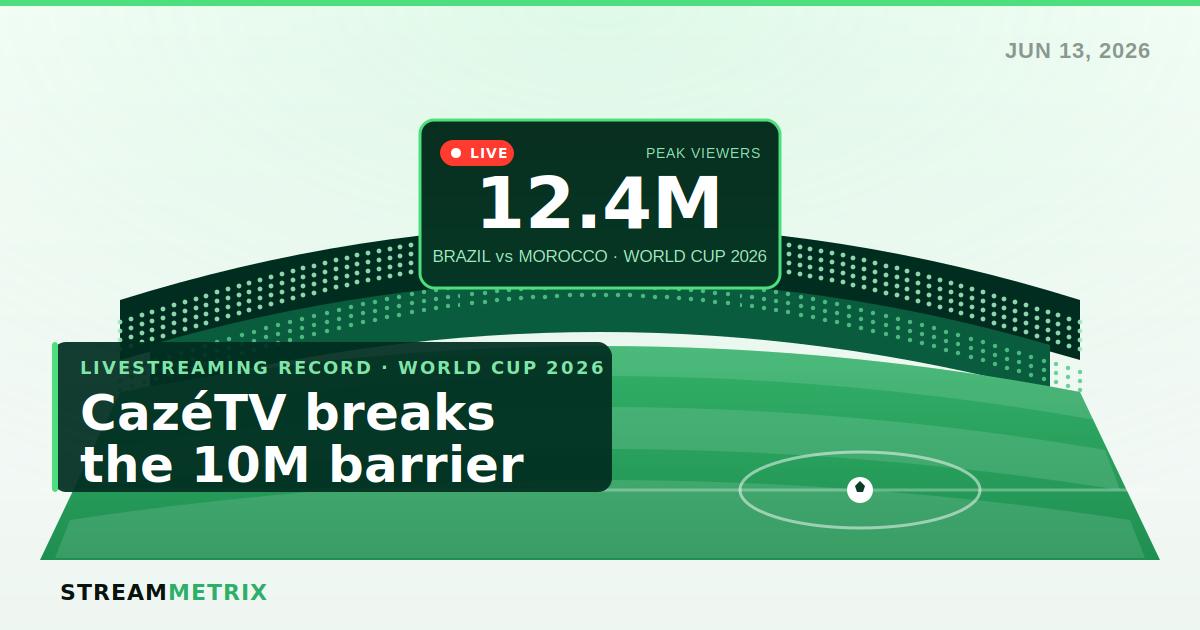
CazéTV pulled in 12.4 million peak viewers during Brazil's 2026 FIFA World Cup opener against Morocco, becoming the first individual channel anywhere outside China to cross 10 million concurrent viewers. The same broadcast pushed YouTube past 20 million platform-wide for the first time, a milestone no livestreaming service had reached before.
What makes the number land harder than the number itself is how it was earned: not by a studio with a marketing budget behind a paywall, but by a free YouTube channel fronted by a single creator. That distinction is the whole story.
How many viewers did CazéTV get for Brazil vs Morocco?
CazéTV, run by Casimiro Miguel, peaked at 12.4 million viewers on June 13 while broadcasting Brazil's draw with Morocco. No channel — solo creator or studio operation — had ever passed 10 million on its own before. The closest anyone had come was Ibai Llanos, whose channel touched 9.33 million during La Velada del Año V. CazéTV did not edge past that mark so much as leap over it, clearing a threshold that had stood as a kind of ceiling for individual broadcasters.
Stacked against the previous benchmarks, the jump is easier to feel than to describe:
| Channel / platform | Peak viewers | Event |
|---|---|---|
| CazéTV (individual record) | 12.4M | Brazil vs Morocco, 2026 World Cup |
| Ibai Llanos (previous individual best) | 9.33M | La Velada del Año V |
| YouTube (new platform record) | 20.2M | Brazil vs Morocco, 2026 World Cup |
| YouTube (previous platform record) | 19.6M | ASEAN Championship, early 2025 |
The free-to-air angle did a lot of the work here. CazéTV holds the rights to all 104 matches of this World Cup and streams every one of them at no cost on YouTube, in 4K. When the only way to watch the national team for free is a single creator's channel, the audience concentrates fast.
Why did YouTube hit a new platform record?
YouTube Live peaked at 20.2 million concurrent viewers during the match, becoming the first platform to clear the 20 million barrier. Its previous high sat just under 19.6 million, set during the ASEAN Championship at the start of 2025. CazéTV's stream was the engine behind the jump — a useful reminder that platform records are usually built on the back of one outsized broadcast rather than steady, distributed growth.
What pushed the numbers this high
A few factors stacked on top of each other to produce the record:
- Free, exclusive access. CazéTV is the only channel — digital or traditional — with rights to every match in Brazil, with no paywall or sign-in wall on the live stream.
- A national-team opener. Brazil's first match of a World Cup is one of the most-watched moments in the country's sporting calendar, concentrated into a single broadcast.
- A creator-led format. The informal, conversational style and creator commentary keep younger viewers in the stream rather than dipping in and out.
- 4K distribution. Higher production quality removed the old "watch it properly on TV" reflex that used to cap streaming audiences.
For scale, CazéTV reportedly surpassed 30 million subscribers during the tournament. The channel was already the largest sports channel on YouTube in Brazil before a ball was kicked.
One free YouTube channel, fronted by a single creator, now draws the same conversation — and the same matches — as the broadcast networks that owned this market for decades.
How did FIFA's streaming strategy set this up?
This record did not happen by accident. FIFA spent the last cycle nudging its flagship event toward digital distribution, and 2026 is where that bet pays off. Alongside traditional television, matches are reaching audiences through livestreaming for the first time at this scale: parts of games sit on a dedicated TikTok hub, and watch parties run on the channels of select YouTube creators.
From a 2022 test run to all 104 matches
The groundwork was laid four years ago. For the 2022 tournament in Qatar, FIFA ran what amounted to a test, letting Casimiro broadcast 22 matches on a then-new CazéTV channel. The informal, creator-driven format clicked with younger viewers, and the trial earned CazéTV the rights to every match in Brazil this time around. The traditional incumbent, Globo, holds a far smaller slate of the tournament — a striking inversion of how soccer rights used to be carved up.
Globo still reaches a larger total audience across its networks, so this is not a clean changing of the guard. But the gap that once separated broadcast television from a YouTube channel has narrowed to the point where the two are now spoken about in the same sentence, for the same matches, in the same market.
"New audiences expect authenticity, interaction and different ways to follow an event," said LiveModeTV co-founder Lopes, describing why the format resonates.
Will CazéTV break the record again?
Almost certainly. With every Brazil match and the July 19 final still ahead, the opener is unlikely to stand as the high-water mark for long. Knockout fixtures tend to draw the biggest concurrent audiences, and a free national-team broadcast going deep into the bracket is exactly the kind of event that resets these numbers. The more interesting question is no longer whether a solo channel can compete with broadcast television for a marquee live event, but how often it will now win that comparison.
Want to track how these records move match by match? Follow CazéTV's live viewership on StreamMetrix and explore peak-viewer trends across every major platform.
